
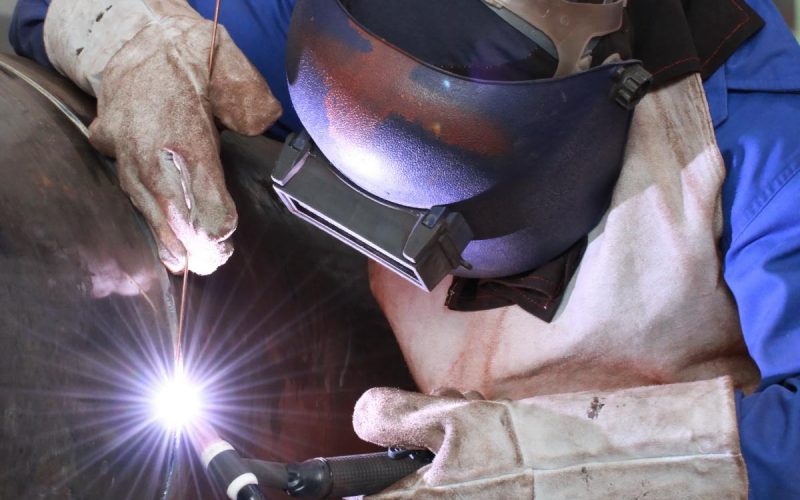
If you’re picking up welding as a hobby, there’s a lot you’ll need to learn, including which metals are suitable for use and which ones aren’t. To help you choose the right material for your projects, let’s look at five of the best metals for welding and what makes them popular selections.
Stainless Steel
Stainless steel is an alloy, which means it’s a mix of multiple elements. Its main components are iron and chromium, with at least 10.5% chromium content.
The chromium forms a passive layer of chromium oxide that protects the steel from corrosion and staining, which is where it gets its “stainless” name.
Its main benefit for welding is its high corrosion resistance. This characteristic is the reason welders choose it for applications requiring exceptional durability against moisture and harsh environmental conditions, like marine components, food processing equipment, and chemical tanks.
Mild Steel
Mild steel, a type of low-carbon steel, is one of the most common metals you’ll find. It has a low carbon content, typically between 0.05% and 0.25%, which makes its properties quite different from higher-carbon steels.
It’s not an alloy steel, so it doesn’t contain large amounts of other elements like chromium or nickel.
Mild steel’s best quality is that it’s easy to weld. Its low carbon content prevents the metal from hardening too much during the heating and cooling cycles of welding. This reduces the risk of cracks and makes for a more stable weld.
Aluminum
Aluminum is a lightweight, silvery-white metal with a low density and natural resistance to corrosion. Unlike steel, it’s a pure element, although for most applications, it’s mixed with other elements to form alloys because pure aluminum is too soft for most industrial applications.
What welders like most about welding with aluminum is that it offers an impressive strength-to-weight ratio. Projects made from aluminum are both strong and light. For applications that need to be easy to handle, but still incredibly strong, aluminum is often the material of choice.
Copper, Bronze, and Brass
While they look similar, copper, bronze, and brass are three distinct materials, and some members of this trio are better for welding than others.
Copper is a reddish-gold metallic element valued for its conductive properties. Bronze is an alloy of copper and tin, while brass is an alloy of copper and zinc.
Of the three, brass is generally considered the best for welding due to its lower melting point and good fluidity when molten. Copper’s high thermal conductivity makes it difficult to weld without specialized techniques, and bronze’s tin content can lead to porosity and cracking.
Titanium
Titanium is a lustrous transition metal with a silver color, low density, and high strength. It’s famous for its resistance to corrosion in seawater and chlorine.
Like aluminum, it’s often alloyed with other elements to enhance its properties, such as increasing its strength, reducing its weight, or improving its resistance to specific conditions.
If you need to create welded parts that can withstand extreme conditions, you may want to use titanium for its exceptional corrosion resistance and high strength. Common applications for it include aerospace components, marine hardware, and chemical processing equipment.
The Right Materials for the Job
These are five of the best types of metal for welding, mainly because they’re strong, durable, and workable. While they’re not the only metals you can use for your projects, they’ll likely be the ones you reach for most often.